

Disclosure in Line with TNFD Recommendations
Disclosure in Line with TNFD Recommendations
Introduction
In 2009, Menicon Co., Ltd. (the “Company”) established the Menicon Declaration on the Environment, expressing our aim to be a “Global company that is kind to people, animals, and the environment.” Across the Group, we are working to ensure that the technologies and expertise we develop can in turn give back to the earth for everything it gives us. In 2022, we also reviewed our sustainability policy and material issues, and we are working to reduce environmental impacts to achieve a “Healthy and spiritually rich society.”
Our Group draws on the benefits provided by natural capital in the operation of our contact lens and care product manufacturing businesses. Contact lenses are classified as specially controlled medical devices, and clean water resources in particular are indispensable in their manufacturing processes. That makes them key to our operations. The international community is becoming more interested in natural capital. We believe it is necessary both to appreciate the benefits we receive from natural capital and to understand our impact on it. We believe that conserving biodiversity and ensuring the sustainable use of ecosystem services will continue to be essential to conducting our business going forward. Accordingly, for this disclosure, we analyzed nature-related risks and opportunities in our core Vision Care Business in line with the LEAP approach.
Our Group will be the first in the contact lens industry to make TNFD disclosures. We aim to lead the industry in efforts to address nature-related issues.
General Requirements
-
Application of Materiality
In assessing the materiality of TNFD-aligned nature-related issues, we apply an approach to materiality that considers two axes: importance to the Company and importance to stakeholders.
-
Scope of Disclosures
In this disclosure, we present the results of our analysis of nature-related issues as they pertain to our core business, the Vision Care Business. The disclosure covers our direct operations and the major upstream and downstream value chains, namely procurement, manufacturing, sales, and disposal and recycling.
-
Regions Facing Nature-Related Issues
Covering 235 domestic and overseas sites of our Group, including plants and sales offices, we identified 49 sites where nature-related issues potentially exist (i.e., areas where particularly careful consideration for the environment is thought to be necessary) using the methodology recommended by TNFD.
-
Integration With Other Sustainability-Related Disclosures
We plan to ensure that disclosures of nature-related issues are aligned with other disclosures and to integrate their content.
-
Period Under Review
For the time horizon used in this assessment of nature-related impacts, the short term is generally defined as the present to 2027, the medium term as 2028 to 2030, and the long term as 2031 onward.
-
Engagement With Indigenous Peoples, Local Communities, and Affected Stakeholders
Our Group has established the Menicon Group Human Rights Policy based on international norms and conducts human rights due diligence in accordance with it. In September 2024, we also established the Sustainable Procurement Guidelines in accordance with the Sustainable Procurement Policy. These guidelines serve as the basis for our requests that suppliers mitigate negative impacts and risks to natural capital and local communities with respect to human rights, the environment, corporate governance, and other matters across the supply chain. In addition, in FY2024, we conducted a questionnaire survey of suppliers involved in product manufacturing and materials. We plan to bring risks to light through the questionnaire and determine solutions as necessary.
Governance
Oversight by the Board of Directors and Management by the Executive Team
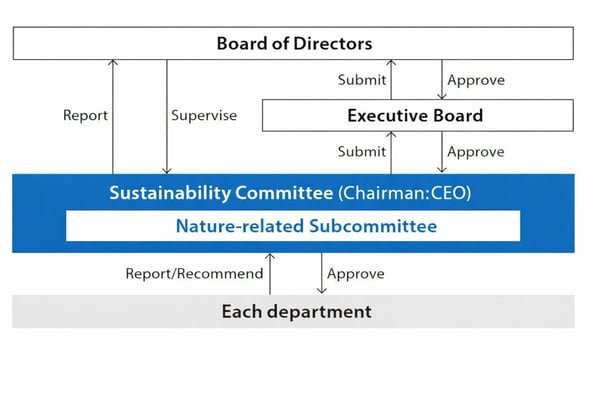
Our Group deliberates on various sustainability-related issues, such as climate change and natural capital, at the Sustainability Committee and determines the basic policies for related activities. The Sustainability Committee is chaired by the Director, President and CEO and is composed, among others, of all executive officers, internal Directors, and the heads of relevant departments. At least four meetings of the Sustainability Committee are scheduled each year. We have also established a subcommittee on nature-related issues to facilitate more focused deliberations. The subcommittee collects information from each department and, as necessary, reviews and discusses matters to be deliberated by the Sustainability Committee, such as the assessment of risks and opportunities related to natural capital and initiatives to address related issues. Of the matters deliberated by the Sustainability Committee, those measures and policies with significant impact on management and similar matters must be approved by the Executive Committee or the Board of Directors. Other matters deliberated are also reported regularly to the Board of Directors, and sustainability management is promoted under the Board’s oversight.
Human Rights Policy and Stakeholder Engagement
We believe we must endeavor to prevent natural capital from being adversely impacted by our business activities, and to show due respect and consideration for stakeholders such as indigenous peoples and local communities. Our Group has established the Menicon Group Human Rights Policy based on the International Bill of Human Rights (the Universal Declaration of Human Rights and the International Covenants on Human Rights), the International Labour Organization Declaration on Fundamental Principles and Rights at Work, and the United Nations Guiding Principles on Business and Human Rights, and we strive to manage our Group in a manner that is respectful of human rights.
In addition, our Sustainable Procurement Guidelines serve as the basis for our requests that suppliers mitigate negative impacts and risks to natural capital and local communities with respect to human rights, the environment, corporate governance, quality and safety assurance, and other matters across the supply chain.
Strategy
Approach to Nature-Related Issues
We believe that, in working toward mitigating environmental impacts (one of our Group’s material issues), understanding the relationships between our current business activities and natural capital and society and implementing measures accordingly is essential for the continuation of our business.
Our business is particularly dependent on natural capital such as water, and changes in natural capital may therefore have an outsize impact on us. In addition, because the plastics that are essential to manufacturing impact natural capital at the raw materials, manufacturing, disposal, and other various stages along the value chain, the continuation and expansion of our business could have a significant impact on natural capital. We believe it is necessary to establish countermeasures in advance in order to avoid or mitigate these impacts on our company and the environment.
This analysis focused on nature-related issues and was conducted in line with the LEAP approach advocated by TNFD, with particular emphasis on the Vision Care Business, the core business of our Group. It covered major value chain activities from procurement through disposal and recycling.
Analysis of Natural Conditions at Our Group Sites [Locate Phase]
We used evaluations of the five assessment items defined by TNFD*1 to analyze the natural conditions at our Group’s sites, such as plants and sales offices. Sites that met the criteria for even one of the assessment items fell under areas requiring particularly careful consideration for the natural environment. 49 of 235 sites (Japan 41, China 1, Europe 7) were identified through this approach. 44 of the 49 sites were thought to have limited dependence and impact on nature, such as the head office and sales offices. The remaining five sites were areas with plants in Japan and overseas and were determined to be more likely to negatively impact nature.
These five sites consist of the Menicon Nect Gujo Plant in Gifu Prefecture in Japan and four overseas plants in China, France, the Netherlands, and the United Kingdom.
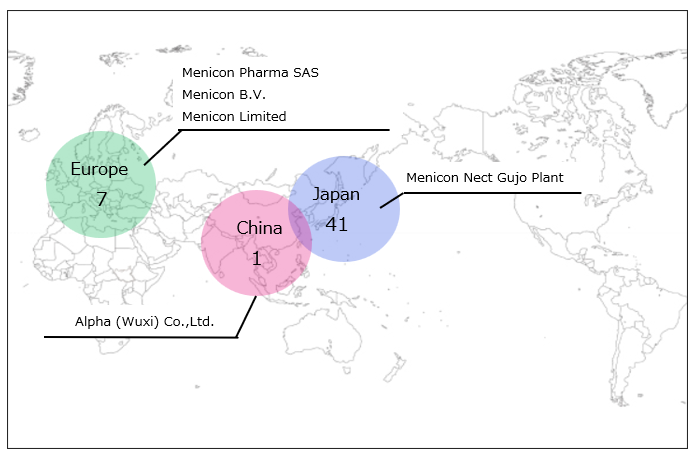
*Site names are listed only for plants located within areas requiring particular consideration for the natural environment.
In Japan
The Menicon Nect Gujo Plant in Gifu Prefecture is adjacent to Okunagaragawa Prefectural Natural Park and fell under the categories of “areas of high ecosystem integrity” and “areas important for biodiversity.”
Overseas
The plants in China, the Netherlands, and the United Kingdom were assessed as having particularly high water quality risk and fell under the category of “areas with high physical water risk.” The plant in France was fell under the category of “areas important for biodiversity.”
*1) We conducted the analysis using the following items and indicators, with reference to the TNFD definitions and recommended data sources.
-
“Areas important for biodiversity” – Indicators: Protected areas (Japan: Ministry of Land, Infrastructure, Transport and Tourism; overseas: IBAT), START score (Mair, L. et al. (2021)), KBA (Japan: Conservation International Japan; overseas: IBAT)
-
“Areas of high ecosystem integrity” – Indicator: Biodiversity Intactness Index (Newbold et al. (2016))
-
“Areas where ecosystem integrity is rapidly declining” – Indicator: Ecoregion Intactness Index (Bayer et al. (2021))
-
“Areas with high physical water risk” – Indicator: Water Availability, Flooding, Water Quality (WWF Water Risk Filter)
-
“Areas where ecosystem services, including benefits to indigenous peoples, local communities, and stakeholders, are important” – Indicators: Critical Natural Asset layers (Chaplin-Kramer, R. et al. (2023)), protected areas (managed by IPLCs) (IBAT)
Identify Dependencies and Impacts on Nature [Evaluate Phase]
We identified and evaluated dependencies on ecosystem services and impacts on natural capital across our Group’s entire value chain and consolidated the results in a heat map.
Dependencies on ecosystem services were identified in direct operations and across the value chain. In direct operations, this includes “water purification” in the manufacture of contact lenses and related products. In the upstream value chain, potential dependencies include “biomass resources in paper procurement” and services such as “climate regulation and water purification,” while in the downstream value chain, a potential dependency on “waste treatment” was also identified.
Meanwhile, it was found that there may be impacts on natural capital such as “ecosystem use,” “discharges of pollutants affecting water quality and soil,” and “disturbances caused by noise, light, and similar factors” across the entire value chain.
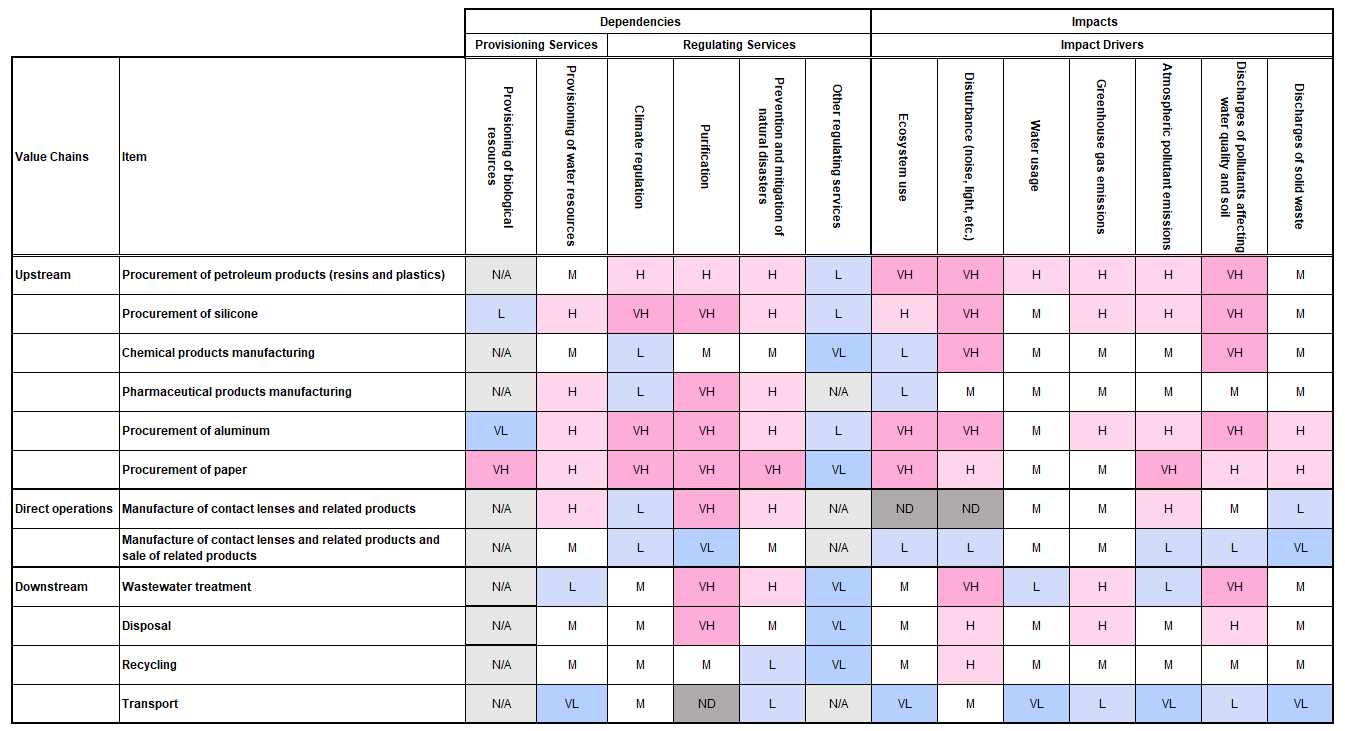
VH: Very High, H: High, M: Medium, L: Low, VL: Very Low
ND: No Data (insufficient evidence), N/A: Not Applicable
Identify and Assess Nature-Related Risks and Opportunities [Assess Phase]
We used the identified dependencies and impacts on nature as the basis for identifying and assessing the nature-related risks and opportunities anticipated for our Group.
In evaluating the materiality of risks and opportunities, we assumed four scenarios mapped along the two axes of ecosystem service degradation (physical risk) and alignment of market and non-market forces (transition risk) recommended by TNFD. We then evaluated risks and opportunities in each scenario in terms of degree (i.e., financial impact) and likelihood.
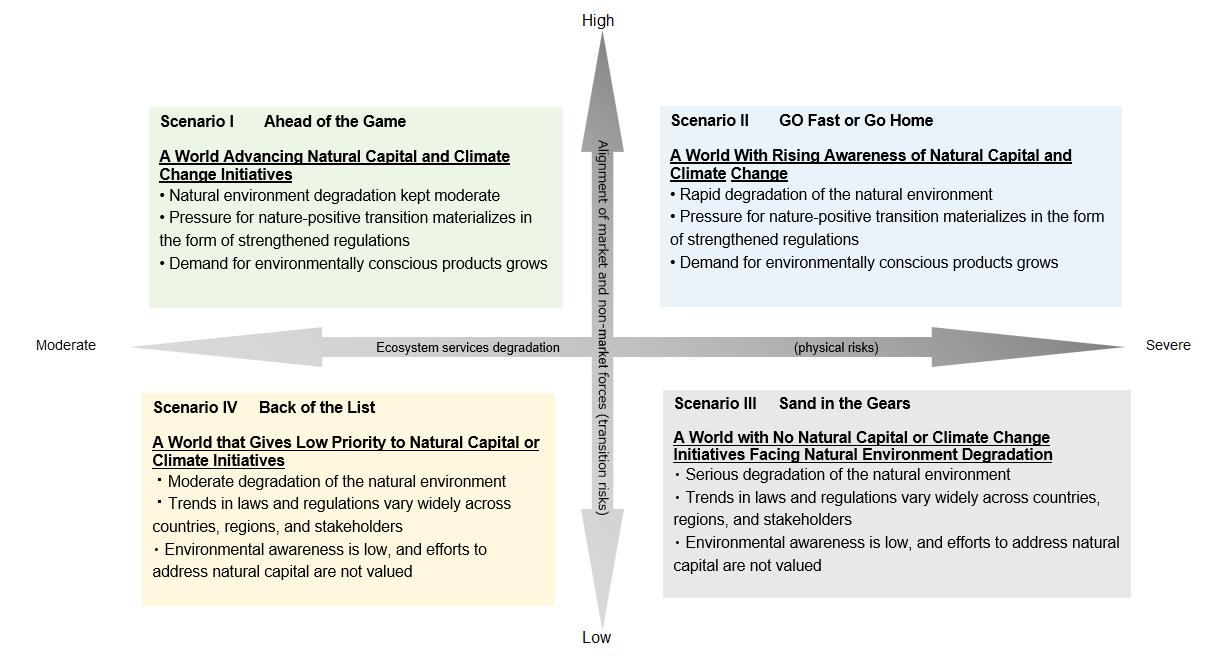
The risks and opportunities considered material for our Group are as follows.
| Types of Risk and Opportunity | Risk Factor Items | Realized / Potential |
Time horizon |
Financial Impact | Countermeasures | |
|---|---|---|---|---|---|---|
| Physical risks | Acute/Chronic | Degradation of water resources due to changes in nature Changes in water volume and water quality resulting from climate change or other changes in nature affecting water sources or their catchments could adversely impact plant operations. |
Potential | Long-term | ・ Increased water withdrawal and treatment costs ・ Sales losses due to operational shutdowns caused by water outages or drought ・ Costs associated with finding and switching to new water sources |
・ Continuously monitor water volumes and establish systems to promptly detect changes in water sources ・ Consider alternative water withdrawal methods ・ Introduce wastewater reuse and circulation systems ・ Reduce water usage and introduce water-saving equipment |
| Acute | Increased exposure to disaster risk for plants and sales sites Degradation of natural ecosystems weakens ecosystem services that mitigate landslides, flooding, and severe storms, potentially increasing damage from natural disasters. |
Potential | Medium-term | ・ Sales losses due to operational shutdowns caused by disaster damage ・ Increased recovery costs ・ Increased disaster prevention costs ・ Increased insurance premiums |
・ Enhanced flood and wind resistance measures for plant buildings and equipment (e.g., waterproof walls) ・ Establishment and BCP training of domestic and international alternative sites for operational transfer during disasters ・ Review the Business Continuity Plan (BCP) and incorporate nature-related risks into the BCP in anticipating natural disasters driven by climate change. |
|
| Acute/Chronic | Reduced production in supply chains Degradation of natural ecosystems leads to water shortages or more frequent natural disasters within the supply chain, impacting the production and distribution of raw materials and potentially leading to procurement risks. |
Potential | Medium-term | ・ Sales losses due to decreased operating capacity caused by difficulties in procuring raw materials ・ Increased procurement costs |
・ Engage with multiple suppliers ・ Diversify raw material procurement routes to avoid reliance on particular locations subject to natural risk ・ Undertake initiatives that contribute to ecosystem restoration, such as local tree-planting activities ・ Introduce green infrastructure (develop green spaces around plants to serve as rainwater retention areas and reduce flood risk) |
|
| Transition risks | Policy | Increased management costs due to strengthened environmental regulations Strengthened regulations on pollutants, waste requirements, mitigation of impacts on ecosystems, conservation measures, and related matters may lead to increased management costs in product manufacturing processes. |
Potential | Medium-term | ・ Increased management costs ・ Increased countermeasure costs and facility investments ・ Decreased sales (if responses are inadequate) |
・ Plan budgets in anticipation of future regulatory responses ・ Gather information on environmental regulations |
| Policy | Strengthened regulations on disposable plastic products As issues related to plastic waste become more severe and regulations on plastic products, including our own, are tightened, countermeasure costs may increase. |
Potential | Medium-term | ・ Increased management costs ・ Increased countermeasure costs and facility investments ・ Decreased sales (if responses are inadequate) |
・ Plan budgets in anticipation of future regulation of plastic |
|
| Market |
Changed production environments in the supply chain
|
Potential | Medium-term | ・ Increased procurement prices ・ Price spikes and procurement difficulties due to reduced raw material supply ・ Declines in customer demand due to higher product prices |
・ Identify key supply-chain sites and collect information on local natural environments |
|
| Reputation and liability for damages |
Reputational damage and exposure to liability arising from improper management of pollutants, waste, and other byproducts Improper handling of pollutants or waste in manufacturing or sales could, if discovered, lead to reputational damage and other consequences. |
Potential | Medium-term | ・ Diminished corporate value ・ Reduced sales (customer attrition due to reputational damage) ・ Lower employee engagement ・ Burdens from fines, compensation payments, and removal costs |
・ Adhere to pollutant and waste handling protocols ・ Improve transparency via more robust disclosure of our environmental conservation activities ・ Implement environmental improvement projects in collaboration with local communities ・ Manage wastewater and exhaust facilities properly |
|
| Opportunities | Resource efficiency | Efficient use of resources Adjustments to product specifications or processes, using recycled materials, and similar measures can reduce costs in addition to mitigating impacts on the natural environment. Using highly sustainable resources can help reduce procurement risk. |
Potential | Medium-term | ・ Reduced manufacturing costs ・ Increased sales through improved corporate value and reputation ・ Increased sales through access to environmentally-conscious markets |
・ Improve manufacturing processes ・ Introduce recycling technologies ・ Transition to a circular economy |
| Introduction of water-saving facilities Improving water-use efficiency in manufacturing processes can cut water-related costs and improve water security. |
Potential | Medium-term | ・ Reduced operating costs ・ Improved water security |
・ Deploy water-saving equipment ・ Review production processes ・ Reduce volumes of natural resources used through more advanced recycling technologies |
||
| Promotion of product recycling Promoting the recycling of plastics can help reduce plastic pollution, avoid environmental impacts, and yield other positive outcomes. Increases in demand for recycled plastics may allow them to contribute to revenue as value-generating materials. |
Potential | Medium-term | ・ Improved procurement resilience ・ Increased sales through improved asset value and reputation ・ Increased sales through access to environmentally-conscious markets |
・ Change product designs to only one easily-recycled material, and adopt reusable containers and packaging ・ Set waste-reduction targets and follow through on them ・ Set targets for increased use rates of recycled plastics (PCR) and promote their use ・ Enhance and expand the impact and scale of the 1case Project |
||
| Market Products and services |
Expanded uptake of products and businesses that reduce environmental impact Developing products that help reduce environmental impacts increases uptake and scales related businesses, resulting in higher net sales. |
Potential | Medium-term | ・ New sources of revenue ・ Increased sales through access to new markets ・ Increased sales through business diversification |
・ Promote the 1case project ・ Roll out eco-friendly products (products using recycled materials, products with resource-saving design) |
|
| Reputational capital | Improved reputation through contributions to nature-positive initiatives Reducing environmental impacts across product life cycles and collaborating with local stakeholders to deliver positive environmental impacts improves the company’s standing and that of its assets. |
Potential | Medium-term | ・ Improved reputation and corporate value ・ Increased sales through expansion of market share |
・ Enhance disclosures in line with TNFD guidelines (proactively communicate nature-related initiatives and advance dialogue with stakeholders) ・ Disclose information through various reports (e.g., the Menicon Report) and the company website ・ Collaborate with local communities to carry out activities in support of nature-positive initiatives |
|
Responses to Nature-Related Risks and Opportunities
The subcommittee will use the results of this analysis as the basis for formulating countermeasures.
Risk and Impact Management
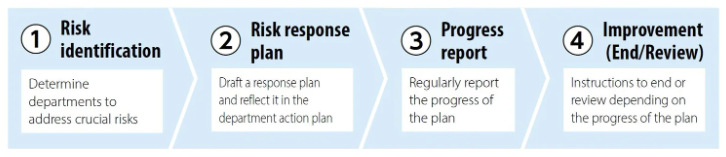
Our Group has established a framework and procedures for risk management (including the management of adverse impacts) with the objectives of avoiding or mitigating losses and other issues by preserving company assets, ensuring stakeholder safety, and maintaining business continuity. Nature-related risks will also be managed and monitored within the overall risk management process.
-
Identifying Risks
The Sustainability Department collects information from each department at least once per year on the status of responses to changes in the internal and external environment and consolidates the identified risks. These risks are then reviewed by the Sustainability Committee together with companywide business risks such as geopolitical risks and foreign exchange risk to determine the material risks to be addressed.
-
Risk Response Plans
The departments that will be responding to the risks formulate response plans.
-
Progress Report
The departments that will be responding to the risks provide periodic progress reports to the Sustainability Committee and elsewhere.
-
Revision
The Sustainability Committee provides revision instructions based on the progress made thus far on the response plans, if necessary.
-
Risk Monitoring
Each department monitors the identified risks and reports to the Sustainability Department if any changes occur.
Metrics and Targets
Our Group discloses ESG data on waste, water withdrawal, and wastewater discharge as metrics for nature-related dependencies, impacts, risks, and opportunities.
Going forward, we will continue to investigate metrics and targets to facilitate management of our Group’s nature-related dependencies, impacts, risks, and opportunities, with reference to the disclosure metrics recommended by TNFD.