

Disclosure in Line with TCFD Recommendations
Disclosure in Line with TCFD Recommendations
The Menicon Group considers climate change to be an important issue. Since 2021, we have conducted the Scenarios Analysis to improve our resilience against climate change over a mid-to-long term period. In April 2022, we established an organization to discuss and review sustainability issues, including climate change, in greater depth, and in July we announced our support to the TCFD Recommendations. In the future, we will expand our initiatives in line with TCFD framework, continue to strengthen our resilience, and enhance disclosure of climate-related financial information.
Governance
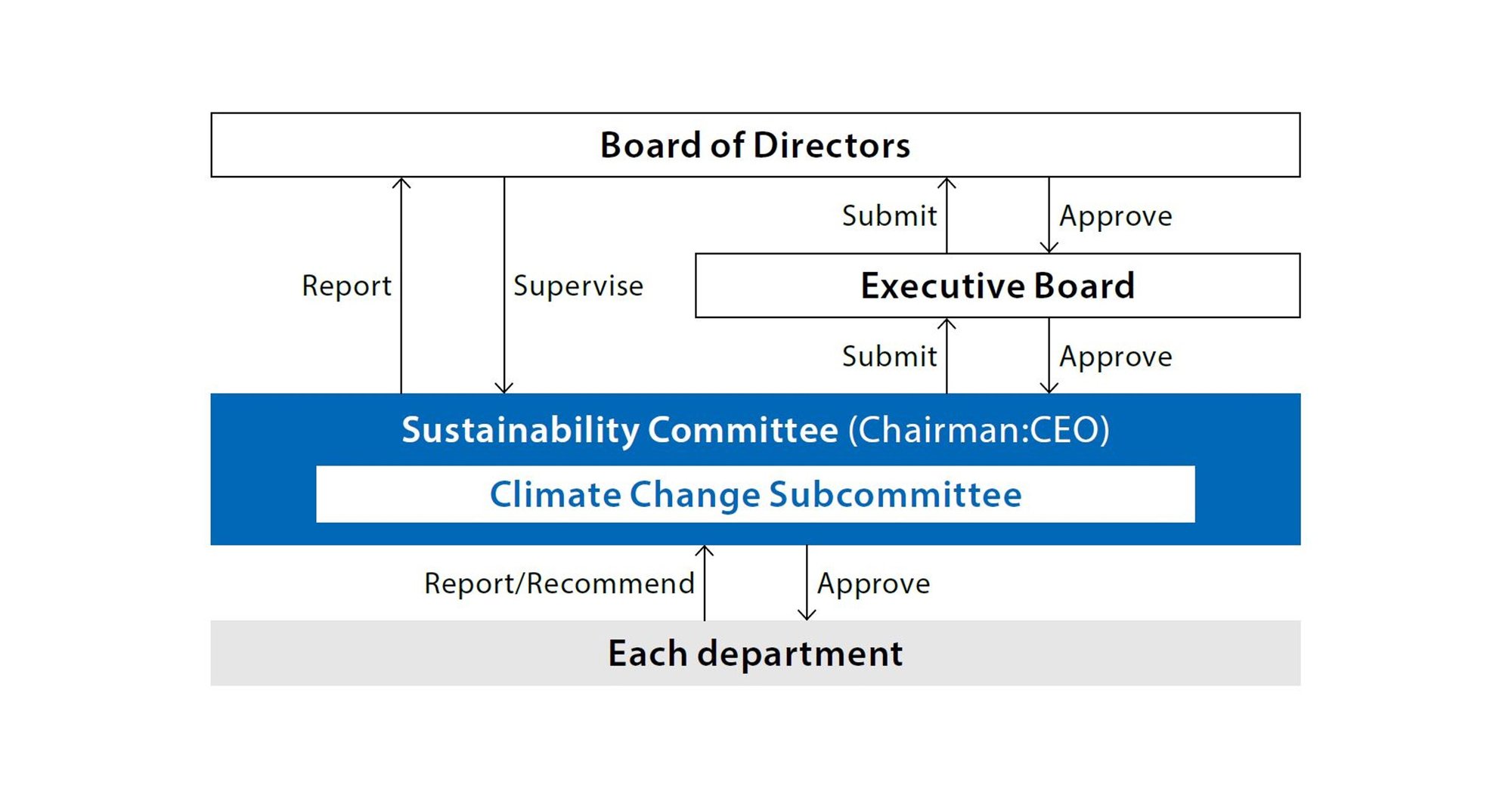
The Menicon Group discusses issues related to climate change at the Sustainability Committee and determines the basic action policies. The Sustainability Committee is led by our CEO, and consists of all our executive officers, internal directors, and heads of related departments. They are scheduled to meet more than four times a year. We have also set up a subcommittee on climate change issues which collects information from each department and review the contents to be discussed by the Sustainability Committee, such as evaluating risks and opportunities related to climate change and initiatives to address issues, as necessary. Among the content discussed in the Sustainability Committee, measures and policies that will have impacts on management will be approved by the Executive Committee and Board of Directors. Other matters which were discussed are also regularly reported to the Board of Directors. Sustainability management is promoted under the supervision of the Board of Directors.
Strategy
Analysis process
The Menicon Group has examined the impact of climate change issues on our business, while referring to the items of risks and opportunities indicated in the TCFD recommendations. Using both the 1.5°C scenario and the 4°C scenario, we conducted analyses concerning changes in policies and market trends (transition risks and opportunities) and physical changes due to disasters (physical risks and opportunities). Through these analyses, we identified risks and opportunities, and analyzed and formulated the degree of impact on the business and countermeasures.
Climate change scenarios
◆ 1.5°C scenario (decarbonization transition scenario)
This is the 1.5°C scenario, which aims to limit the global average temperature rise to less than 1.5°C compared to pre-industrial levels by actively promoting global efforts to achieve carbon neutrality in order to curb the impacts of climate change. In this scenario, it is anticipated that stricter regulations, the introduction of carbon taxes, and the strengthening of emissions trading systems will be required in countries around the world to accelerate the reduction of greenhouse gas emissions. Therefore, the impact of policy and regulatory risks is expected to be greater compared to the 2°C scenario. In addition, companies are expected to be strongly required to rapidly transition to decarbonization technologies and renewable energy, and responses to these are expected to significantly impact corporate competitiveness and market valuation.
◆ 4°C scenario (high emissions scenario)
This is a scenario in which climate change measures do not progress beyond current efforts, and the global average temperature is expected to rise by about 4°C by the end of this century compared to pre-industrial levels. In this scenario, the intensification of extreme weather events becomes prominent as physical risks, with increases in the frequency and intensity of typhoons, heavy rains, and heatwaves expected. In addition, due to a rise in the sea level, the risk of flooding in coastal areas will increase, potentially causing severe impacts on people’s livelihoods and infrastructure. In this manner, the 4°C scenario is projected to cause widespread and severe impacts across society, the economy, and the natural environment.
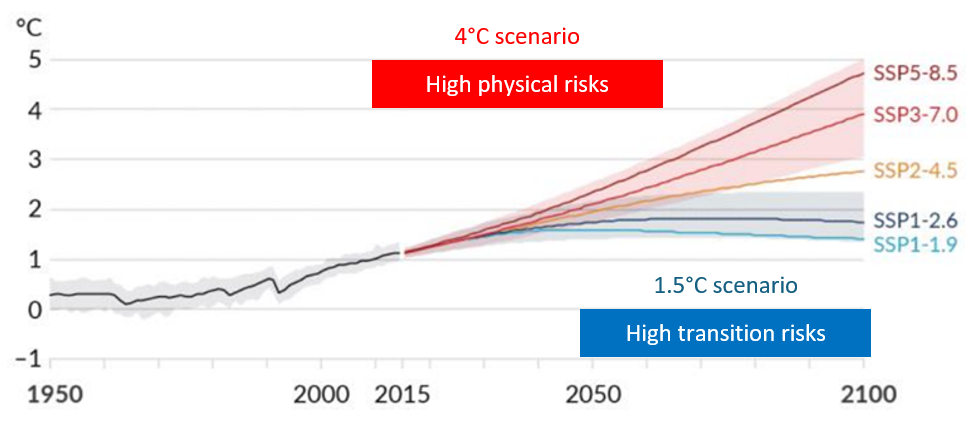
Source: IPCC Sixth Assessment Report, Working Group I Report, Summary for Policymakers, Provisional Translation (Ministry of Education, Culture, Sports, Science and Technology and Japan Meteorological Agency)
Reprinted from Figure SPM.8 in the IPCC Sixth Assessment Report, Working Group I Report, Summary for Policymakers, Provisional Translation (Ministry of Education, Culture, Sports, Science and Technology and Japan Meteorological Agency)
Main climate-related risks and opportunities
Based on TCFD recommendations, we analyzed the impacts on our business using the 1.5°C scenario (IEA NZE 2050) where transition risks materialize and the 4°C scenario (RCP8.5) where physical risks materialize.
In the 1.5°C scenario, carbon costs (carbon taxes and emissions trading), strengthened regulations, and increasing customer demands for decarbonization affect revenue and cost structures, while the increase in demand for low-carbon products and services presents opportunities. In response to this, we will expand procurement of renewable power, promote electrification, and improve energy efficiency to capture revenue opportunities and mitigate cost increases.
In the 4°C scenario, risks increase significantly due to frequent flooding, storm surges, and extreme heat, potentially damaging our own facilities and those of key suppliers, causing operational shutdowns, and disrupting logistics. In response to this, we will strengthen resilience through flood countermeasures and redundancy based on hazard assessments for each facility, location diversification and securing alternative procurement, and enhancement of BCP, thereby minimizing business interruption risks and response costs.
Based on this analysis, we will implement emission reductions and adaptation measures in alignment with medium-term plans and investment plans, and convert climate change into medium- to long-term growth opportunities in the aim to establish a resilient business structure and sustainable revenue base.
| Type of risks |
Factors (Drivers) |
Indicator | Time horizon *1 |
Impact on business | Impact level *2 | Anticipated countermeasures | ||
|---|---|---|---|---|---|---|---|---|
| Qualitative | Quantitative | |||||||
| Transition risks |
Regulations and policies
|
Increase in carbon prices |
Expenditures |
Short-term to long-term |
The introduction of carbon taxes will cause additional costs based on our Scope 1 and 2 emissions, which will increase operating costs |
Medium |
Medium |
|
|
Strengthening of GHG emission reduction regulations |
Expenditures |
Medium-term to long-term |
Due to the strengthening of GHG emission reduction regulations, responses such as purchasing renewable energy generation equipment and introducing high-efficiency production equipment will be necessary, which will increase investment costs |
High |
ー |
|
||
|
Strengthening of GHG emission reporting obligations |
Expenditures |
Medium-term to long-term |
Due to increased demand for carbon offsets to achieve emission reduction targets, carbon credit prices will rise, which will increase reduction costs |
High |
ー |
|
||
|
New legal regulations on products and services |
Revenue |
Medium-term to long-term |
Strengthened regulations on the ratio of recycled plastic use in packaging materials will create risks of sales restrictions for non-compliant products, which will lead to lost sales opportunities and a decrease in sales |
Medium |
High |
|
||
|
Expenditures |
Medium-term to long-term |
If regulations on waste recycling methods are strengthened or new regulations are introduced, response costs will be incurred |
Medium |
Low |
|
|||
|
Technology |
Costs for transitioning to low-emission technologies |
Expenditures |
Medium-term to long-term |
Investment costs will increase for technologies related to improving energy-saving performance of products (such as product design changes or introduction of new manufacturing processes) |
High |
ー |
|
|
| Market |
Changes in customer behavior |
Revenue |
Medium-term to long-term |
As consumers prioritize products and services that reduce environmental impact, demand for conventional products will decrease, leading to a reduction in net sales |
Medium |
High |
|
|
|
Reputation |
Increase in stakeholder concerns or negative stakeholder feedback |
Other |
Short-term to medium-term |
Delays in GHG reduction efforts or insufficient information disclosure will lower evaluations from investors, making raising funds difficult |
Medium |
ー |
|
|
|
Physical risks |
Acute |
Increase in severity of extreme weather events such as cyclones and floods |
Revenue |
Short-term to long-term |
Damage to our plants will cause stagnation or shutdown of production activities, leading to a decrease in net sales |
High |
Medium |
|
|
Revenue |
Short-term to long-term |
Damage to plants of suppliers will cause stagnation or shutdown of parts and raw material supplies, affecting our production and leading to a decrease in net sales |
High |
ー |
|
|||
| Chronic |
Changes in precipitation patterns and extreme variability in weather patterns |
Expenditures |
Medium-term to long-term |
Increased risk of water resource depletion or revisions to water utility rates will lead to an increase in water usage costs |
High |
ー |
|
|
|
Rise in average temperatures |
Expenditures |
Short-term to long-term |
Costs for employee heatstroke countermeasures (or safety and health measures) will increase with the rise in average temperatures |
Low |
ー |
|
||
| Types of opportunities |
Factors (Drivers) |
Indicator | Time horizon *1 |
Impact on business | Impact level *2 | Anticipated countermeasures | ||
|---|---|---|---|---|---|---|---|---|
| Qualitative | Quantitative | |||||||
|
Opportunities |
Resource efficiency |
Use of more efficient production and distribution processes |
Expenditures |
Short-term to long-term |
Reduce operating costs by implementing product specifications and manufacturing processes that enable reduced resource usage |
Medium |
ー |
|
|
Energy sources |
Transition to distributed energy sources |
Expenditures |
Short-term to long-term |
Introduction and expansion of solar power generation and energy storage technologies will reduce electricity purchase costs |
Low |
ー |
|
|
|
Products and services |
Expansion of water-stressed regions |
Revenue |
Medium-term to long-term |
Increase in net sales of 1-DAY lens, which reduce water usage during production and use, due to the expansion of water-stressed regions |
High |
ー |
|
|
|
Changes in consumer preferences |
Revenue |
Medium-term to long-term |
Due to frequent extreme weather, the shift to remote work and decrease in outdoor activities will increase opportunities for eye strain, which will lead to an expansion of the myopic population and heightened needs for myopia control and increase net sales |
High |
ー |
|
||
|
Spread of products and businesses that reduce environmental impact |
Revenue |
Medium-term to long-term |
Growth in demand for environmentally low-impact agricultural materials, fertilizers, etc., will increase net sales |
Low |
High |
|
||
|
Spread of products and businesses that reduce environmental impact |
Revenue |
Medium-term to long-term |
By promoting product designs considering resource circularity (circular economy) (horizontal recycling and upcycling of packages), we can utilize resources as sales products through the construction of renewable systems, which will increase net sales |
High |
ー |
|
||
|
Market |
Development and/or expansion of low-emission goods and services |
Revenue |
Medium-term to long-term |
Providing environmentally friendly goods and services will expand sales volume to environmentally conscious customers, which will increase net sales |
High |
High |
|
|
|
Resilience |
Climate change risk assessment and countermeasures |
Expenditures |
Medium-term to long-term |
Prevent disaster risks proactively through decentralized production sites and backup power systems, and reducing response costs associated with business interruptions |
Low |
ー |
|
|
*1 Definition of time horizon:
[Short-term: Present to 2027] [Medium-term: 2028 to 2030] [Long-term: 2031 onward]
*2 Definition of impact level:
[Qualitative] Magnitude of impact x probability of occurrence
• High: Serious impact on overall management (operational shutdown, long-term disruption, major losses, etc.) and/or high probability of occurrence within the assumed period
• Medium: Significant impact on business operations (partial profitability deterioration, loss of market share, etc.) and/or moderate probability of occurrence
• Low: Minor impact (limited effect on operations/market share) and/or low probability of occurrence
[Quantitative] Financial impact amount (annual)
• High: JPY 1.0 bn or more / Medium: JPY 100 mn to JPY 1.0 bn / Low: Less than JPY 100 mn
*Opportunities are evaluated at the same threshold as positive impacts increasing revenue or profit
Implementation of financial impact assessment
For high-priority climate-related risks and opportunities, we quantitatively analyze and evaluate the impacts on the business to enhance decision-making such as the Medium-term Management Plan and capital allocation. As part of this assessment, the estimation results regarding climate change risks associated with the introduction of carbon pricing are shown below.
[Summary of carbon tax burden calculation]
As countries accelerate the introduction of carbon taxes and emissions trading systems, we identified the impact on our business as “additional costs based on our Scope 1 and 2 emissions, which will increase operating costs.” Therefore, to assess the quantitative financial impact, we have calculated the carbon tax burden based on the assumed Scope 1 and 2 emissions in 2030 as follows.
| Breakdown of financial impact calculation | |
Approximately
|
[Calculation policy] (1) BAU scenario: No reduction measures, incorporating business expansion leading to an increase in Scope 1 and 2 (2) Transition scenario: Advancing renewable energy introduction, efficiency improvements, electrification, fuel switching, and other measures lead to the achievement of Scope 1 and 2 targets while incorporating business expansion
|
[Estimation results and calculations]
| (1) BAU scenario |
(2) Transition scenario | |
| 2023 S1+2 emissions (results) | 25,240 t-CO2 | 25,240 t-CO2 |
| 2030 S1+2 emissions (projected) | 35,090 t-CO2 | 14,387 t-CO2 |
| Carbon price | JPY 21,361 / t-CO2 (common) | |
| Annual estimated cost burden |
Approximately JPY 750 mn |
Approximately JPY 310 mn |
The above estimation results clearly demonstrate that implementing countermeasures can significantly avoid increased carbon costs, even considering business expansion.
[Main countermeasure]
- Renewable energy power contracts (power with non-fossil certificates, ensuring additionality assurance)
- Introduction of self-consumption renewable energy through solar panel installation
- Energy efficiency improvements through high-efficiency equipment upgrades (air conditioning, lighting, etc.)
- Reduction of combustion-derived emissions through the introduction of biomass boilers
Risk Management
Regarding risk management, the Menicon Group has established a risk management system and procedures to avoid or reduce losses, protect company assets, ensure security for stakeholders, and strive for business continuity. Climate-related risks will also be managed and monitored in the overall risk management process.

- Risk identification
The Sustainability Department collects information on the company’s response to internal and external environmental changes from each department more than once a year. The department then sorts out the identified risks, and the committee chairman determines the important risks after deliberation by the Sustainability Committee. - Risk response plan
The Risk Response Department drafts a action plan. - Progress report
The Risk Response Department regularly reports on the progress of the plan at the Sustainability Committee meeting or other meeting. - Review
The Sustainability Committee instructs the plan to be reviewed as necessary depending on the progress of the response plan. - Risk monitoring
Each department monitors the identified risks and reports any changes to the Sustainability Department.
Indicators and Targets
As an indicator, the Menicon Group has started calculating its Scope1+2 Greenhouse Gas (GHG) emissions since FY2020, and is currently in the process of calculating emissions for the upstream and downstream parts of the supply chain (Scope3). We plan to discuss our GHG emissions reduction targets based on the calculation result of Scope 3.
GHG Emissions
*The units for the figures in this table are 1000t-CO2
*Limited to Menicon Co., Ltd. and group companies
| FY2022 Results | FY2023 Results | FY2024 Results | ||
|---|---|---|---|---|
| Scope 1+2 | 22.27 | 25.24 | 22.54 | |
| Scope 1 | 3.92 | 3.93 | 4.81 | |
| Scope 2 | 18.35 | 21.31 | 17.73 | |
| FY2022 Results | FY2023 Results | FY2024 Results | ||
|---|---|---|---|---|
| Scope 3 - indirect emissions other than Scope 1 and 2 | 178.75 | 192.22 | 204.90 | |
| Category 1 - Purchased goods and services | 116.70 | 130.15 | 137.74 | |
| Category 2 - Capital goods | 35.34 | 28.74 | 30.46 | |
| Category 3 - Fuel- and energy-related activities not included in Scope 1 or 2 | 4.02 | 4.30 | 4.15 | |
| Category 4 - Upstream transportation and distribution | 7.52 | 10.49 | 12.41 | |
| Category 5 - Waste generated in operations | 0.41 | 0.48 | 0.51 | |
| Category 6 - Business travel | 1.86 | 4.11 | 3.84 | |
| Category 7 - Employee commuting | 1.10 | 1.14 | 1.27 | |
| Category 8 - Leased assets (upstream) | N/A | |||
| Category 9 - Downstream transportation and delivery | N/A | |||
| Category 10 - Processing of sold products | N/A | |||
| Category 11 - Use of sold products | 1.46 | 1.37 | 2.50 | |
| Category 12 - Disposal of sold products | 10.34 | 11.44 | 12.01 | |
| Category 13 - Downstream leased assets | N/A | |||
| Category 14 - Franchises | N/A | |||
| Category 15 - Investments | N/A | |||
*The units for the figures in this table are 1000t-CO2
*The figures in this table are totals for the following companies: Menicon Co., Ltd., Menicon Nect Co., Ltd., W.I. System Co., Ltd., Menicon Singapore Pte. Ltd., Itabashi Trading Co., Ltd., Itabashi Medical (Dalian)Co., Ltd.
*The emissions in Category 1 of FY2022 and FY2023 were changed due to a close examination of the data tallying method in June 2025.
GHG emission reduction target
| FY2023 | |
| Scope 1+2 | More than 43% reduction (reference year: FY2023) |
Other Indicators and Targets
Menicon Co., Ltd. has a target to reduce the average energy intensity by 1% or more each year over five fiscal years. (Energy intensity: Production quantity or total floor area)