



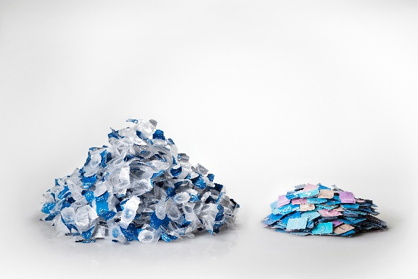
The environmental impact of disposable contact lenses depends not only on the lens itself but also on the amount of individual packaging used for each lens, and slimmer, lower-volume packaging and simpler manufacturing are among the effective ways to reduce it1. A person who wears daily disposable (DD) lenses in both eyes every day uses 730 lenses, and 730 individual packages, in one year1. At the same time, contact lenses are medical devices, and packaging affects hygiene when the lens is handled before insertion; any environmental improvement must therefore not compromise hygiene or ease of use1,2. This article covers the issue, general approaches to reducing packaging impact, the supporting research evidence, and, as one example, the Miru 1day Flat Pack.
Why Contact Lens Packaging Is an Environmental Concern
Daily disposable lenses are packaged one lens at a time, so packaging waste rises in proportion to the number of lenses used, and consumer and wearer interest in the issue is growing.
The UK Chartered Institute of Marketing (CIM) reports that 8 in 10 adults want businesses to focus on sustainability and reduce excess product packaging to help the environment1. Consumers who are more eco-conscious are also willing to pay, on average, about 20% more for products that benefit the planet1. Surveys of contact lens wearers show a similar tendency1.
Table 1: Survey data on consumer attitudes toward packaging and the environment
(Sources: Retallic N. Flat pack formation. Optician. 2022 Nov 4:27-29.)
|
Survey item |
Result |
Population |
|
Want businesses to focus on sustainability and reduce excess packaging |
8 in 10 (about 80%) |
Adults (general public) |
|
Willingness to pay for products with environmental benefits |
About 20% more on average |
Eco-conscious consumers |
|
Rate the environmental impact of contact lenses as “important” or “very important” |
87.5% |
Contact lens wearers |
|
Say manufacturers should treat environmental aspects as a “medium” or “high” priority |
97.5% |
Contact lens wearers |
Three General Approaches to Reducing Contact Lens Packaging Impact
Packaging impact can be addressed from three angles: (1) slimmer, lower-volume packaging, (2) less solution and material inside the pack, and (3) simpler manufacturing.
This grouping is our own summary and does not cover every manufacturer's initiatives. The contact lens industry is reported to be developing more eco-friendly packaging and reducing waste1.
- Slimmer, lower-volume packaging: The smaller the thickness and volume of a package, the smaller the bulk of the same number of units when shipped and discarded.
- Less solution and material: Conventional blisters (bowl-shaped containers) hold enough solution to immerse the lens. Reducing the solution volume also allows the overall package to be smaller.
- Simpler manufacturing: Streamlining the process itself, for example by reducing the number of molds used to produce lenses, is another approach1.
However, changing package size also changes how the lens is handled. Whether a finger can avoid the back (cornea-facing, inner) surface and whether the lens orientation is easy to identify bear directly on hygiene, so these points must be evaluated alongside environmental goals1,2.
How Packaging Design Affects Microbial Contamination During Handling: Research Evidence
Packaging structure can affect the amount of microorganisms transferred to the lens back surface during handling, and an in vitro study reported less transfer with slim Flat Pack packaging than with conventional blister packs2.
・Daily Disposable Lenses Are Not Risk-Free
Daily disposable lenses were expected to be hygienically superior, but studies have reported more nuanced findings. Wearer compliance with instructions and contamination from fingers during handling remain concerns.
Table 2: Key prior studies on daily disposable lenses, microbial keratitis (MK), and handling
(Studies cited in the introduction of Nomachi et al., 20132)
|
Study |
Key finding |
Design / country |
|
Dart et al., 20082 |
Relative risk of MK with DD lenses was about 1.56 times that with planned-replacement soft lenses |
Prospective case-control study, UK |
|
Stapleton et al., 20082 |
Annualized MK incidence per 10,000 wearers: 2.0 for DD lenses; 4.2 for DD lenses with occasional overnight use |
Prospective and telephone surveys, Australia |
|
Boost et al., 20112 |
Overnight storage of DD lenses in blister-pack saline resulted in contaminated lenses; about 30% of wearers habitually reused DD lenses |
Published report |
The study by Boost et al. indicates that reusing lenses while using the blister pack as a storage case can increase contamination risk2.
・In Vitro Study of Microbial Transfer With Miru 1day Flat Pack Packaging
Miya Nomachi, M.S., Kotaro Sakanishi, M.S., Hideji Ichijima, M.S. (Research & Development, Menicon Co., Ltd., Nagoya, Japan) and H. Dwight Cavanagh, M.D., Ph.D. (Department of Ophthalmology, University of Texas Southwestern Medical Center at Dallas, USA) compared Miru 1day Flat Pack with four commercially available DD lenses in general blister packs2. Fingers were coated with fluorescein beads (3 to 5 µm, about the size of common bacteria) or with Staphylococcus aureus (a bacterium, commonly called a “germ”), the lens was removed from its package, and transfer to the lens surface was evaluated2.
Table 3: Transfer after handling, Miru 1day Flat Pack vs. conventional blister packs
(Source:Nomachi et al., 20132. n=5 per lens type, mean ± SD.)
|
Measure |
Miru 1day Flat Pack |
Conventional blister packs (4 control products) |
Comparison (ratio) |
|
Fluorescein beads (particles per about 8 mm2) 2 |
38.0 ± 5.0 |
114.4 to 150.0 (mean of each product) |
About 3.0 to 3.9 times fewer (Approx. 67–75% reduction / P<0.05) |
|
S. aureus: colony formation on the lens inner surface |
0 of 5 lenses (none) |
Colonies found on both inner and outer surfaces of all control lenses |
— |
|
S. aureus: total count from both surfaces (CFU/lens) |
6.0 ± 4.0 |
1-Day Acuvue Moist: 20.0 ± 5.8 |
About 3.3 times fewer (Approx. 70% reduction / 1/3.3 of control level, P<0.05) |
With Miru 1day Flat Pack, no colonies formed on the inner surface of any of the five lenses, and adherence was limited to a slight amount on the outer surface2. The authors note that microorganisms on the outer surface are easily washed away by blinking and tears, whereas those on the inner surface are less readily cleared and may raise the risk of ocular infection2. The Optician review, citing Tan et al. (2021)1 and Nomachi et al. (2013)2, states that packaging with SMART TOUCHTM technology reduces the risk of inner-surface contamination during handling by around three to four times compared with conventional packaging1.
・Study Limitations and Appropriate Use
- This was an in vitro study and did not assess contamination during clinical wear. The authors state that prospective clinical studies in long-term wearers are needed2.
- For S. aureus counts, statistical significance (P<0.05) was reported for the comparison with 1-Day Acuvue Moist2.
- Three of the authors are Menicon employees, and one is a Menicon consultant2.
- Even with the Flat Pack, hand washing before insertion is mandatory, and lenses must be discarded after one day and not reused. Eye care professionals should instruct patients accordingly2.
Miru 1day Flat Pack: Slim Packaging and Manufacturing Design
Miru 1day Flat Pack is about 10–12% as thick as a typical blister, and a comparison of one-year supplies (730 lenses) shows an approximately 80% reduction in packaging waste (Menicon data on file)1.
A 2022 article in Optician describes the environmental features of Miru 1day Flat Pack as follows1.
Table 4: Conventional blister pack vs. Flat Pack
(Sources: Retallic N. Optician. 20221; Nomachi et al., 20132.)
|
Item |
Conventional blister pack |
Miru 1day Flat Pack |
|
Package thickness |
Reference (100%) |
About 10–12% of a typical blister |
|
Packaging waste for a one-year supply (730 lenses) |
Reference |
About 80% reduction |
|
Solution volume in the package |
About 0.8 mL |
About 0.2 mL (about one quarter) |
|
Force required to open the package |
Average 18 N |
Average 3.6 N (about one fifth) |
|
Lens manufacturing moulds |
— |
Centraform process: one mould used in production |
In Figure 1 of the article, the roughly 80% waste reduction is presented as a one-year comparison with conventional packaging, and the source is Menicon data comparing the product with a previous Menicon product1. It is not a comparison with other manufacturers' products.
Miru 1day Flat Pack uses SMART TOUCH™ technology, which holds the lens raised in the correct orientation so it can be gently pinched out without touching the inner surface1. Because the pack has no bowl-shaped well and contains only about 0.2 mL of solution, it is also difficult to reuse as a storage case1,2. Around one in three daily disposable wearers report difficulty telling whether a lens is inside out1.
In a clinical study comparing three daily disposable lenses, including Miru 1day Flat Pack (n=30 per lens), follow-up scores were 93.7% for application and 95.5% for removal from the eye, and overall comfort was rated at 86%1. The study was small, and the author of the Optician article is a Menicon employee.
FAQ
Q. Is the main source of contact lens waste the lens itself or the packaging?
A. In daily disposable contact lens use, individual packaging, including blister containers, foils, and secondary boxes, is an important contributor to physical waste because each lens requires a separate package. Therefore, optimizing package size, thickness, and solution volume provides the most significant opportunity for waste reduction.
Q. How can the environmental impact of contact lens packaging be reduced?
A. The main approaches are slimmer, lower-volume packaging, less solution and material, and simpler manufacturing1. In every case, hygiene during handling must not be compromised.
Q. How much packaging waste does the Flat Pack save compared with conventional packaging?
A. Menicon data show an approximately 80% reduction in packaging waste for a one-year supply (730 lenses), compared with a previous Menicon product1. The pack is about 10–12% as thick as a typical blister1.
Q. Does slimmer packaging make hygiene worse?
A. In the in vitro study, fluorescein bead counts with Miru 1day Flat Pack were about 3.0 to 3.9 times lower than with conventional blister packs, and no S. aureus colonies formed on the lens inner surface2. Clinical confirmation of reduced microbial contamination is still needed.
Q. Does using Miru 1day Flat Pack remove the need to wash hands?
A. No. Hands must be washed before inserting lenses, and lenses must be discarded after one day and not reused2.
Q. Can the package be used as a lens storage case?
A. No. Miru 1day Flat Pack has no bowl-shaped container and holds only about 0.2 mL of solution, so using it as a storage case is physically difficult by design2.
Key Takeaways
- Packaging matters: 8 in 10 adults want companies to focus on sustainability and reduce excess packaging, and 87.5% of surveyed wearers rate the environmental impact of contact lenses as important1.
- Three angles for reduction: Slimmer, lower-volume packaging, less solution and material, and simpler manufacturing are the main ways to reduce packaging impact1.
- Hygiene must come with it: Daily disposable lenses are not risk-free, and contamination from fingers during handling is a concern2.
- Evidence: In an in vitro study, Miru 1day Flat Pack showed about 3.0 to 3.9 times fewer fluorescein beads and about 3.3 times lower S. aureus counts than conventional packs2.
- Flat Pack design: About 10–12% of the thickness of a typical blister, with about 80% less packaging waste for a one-year supply (Menicon data on file)1.
References
-
Retallic N. Flat pack formation. Optician. 2022 Nov 4:27-29.
-
Nomachi M, Sakanishi K, Ichijima H, Cavanagh HD. Evaluation of diminished microbial contamination in handling of a novel daily disposable flat pack contact lens. Eye Contact Lens. 2013;39(3):234-238. doi:10.1097/ICL.0b013e31828c0abe
Reviewed by: Menicon Clinical Affairs
Updated: October 23, 2026